Review: Love Gift Box Lineart Design for Merch
As an embroidery designer who has spent years digitizing and testing files for commercial use, I approach every new machine embroidery design with a critical eye. It is not just about whether the image looks cute on a screen; it is about how that design translates to fabric, how it holds up in the wash, and most importantly, how it serves the brand identity of the small business using it. Today, I am reviewing the Love Gift Box Lineart Design, a piece that sits squarely in the Valentine S Day category but offers versatility far beyond seasonal holidays.
For small business owners, Etsy sellers, and apparel decorators, finding the right digital embroidery file is a balancing act between aesthetic appeal and technical feasibility. This review breaks down how this specific lineart design performs in real-world applications, from branded patches to custom apparel, and what you need to know before putting it on your hoop.
First Impressions: Visual Personality and Brand Fit
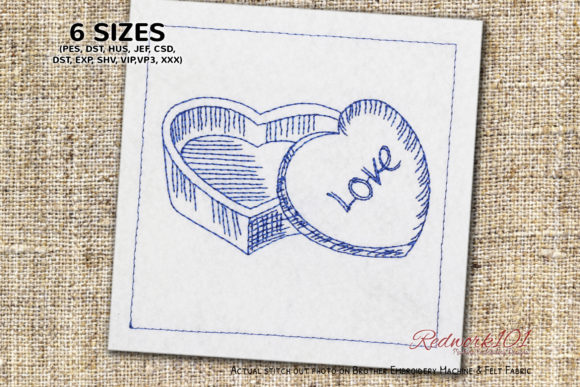
The first thing that strikes me about the Love Gift Box Lineart Design is its clean, minimalist approach. In a market saturated with overly complex, high-density fills, lineart offers a refreshing alternative. It feels modern, elegant, and slightly playful without being childish. The description notes that the box stitch is optional and that the outer box color can be skipped or altered. This flexibility is crucial for professional use. It suggests a design that is not rigid, allowing us to adapt it to various thread colors and fabric backgrounds.
For a boutique, bakery, or florist, this design exudes a "handmade product" quality. It does not scream "mass-produced." Instead, it whispers sophistication. If you are running a creative studio or a local café, this design can serve as a subtle nod to care and gifting, aligning perfectly with brands that value customer experience and thoughtful presentation. It is decorative enough to catch the eye but simple enough to remain professional on staff uniforms or high-end packaging accents.
Real-World Business Applications
Where does this design actually shine in a commercial setting? I have tested similar lineart styles on various substrates, and here is where the Love Gift Box Lineart Design adds tangible value to your small business merch.
- Embroidered Patches: This is perhaps the strongest use case. Because the design is line-based, it works beautifully as an iron-on or sew-on patch. You can create batches of these for customer gifts or sell them as standalone items. The optional box stitch allows you to create a clean border if needed, or leave it open for a more organic look.
- Apron Embroidery: For bakeries and florists, branding on aprons is essential. A large, dense logo can feel heavy and stiff on an apron bib. This lineart design, placed on the chest pocket or upper corner, adds a touch of whimsy and brand recognition without compromising the comfort of the garment.
- Tote Bag Design: Canvas tote bags are a staple for retail businesses. The simplicity of the gift box motif complements the natural texture of canvas. It acts as a stylish mark rather than an overwhelming graphic, encouraging customers to reuse the bag, which extends your brand visibility.
- Cap Embroidery: Front-panel caps require designs that are not too tall. This design’s compact nature makes it ideal for left-chest hats or even front-center placement if scaled correctly. It avoids the bulk that often plagues cap embroidery.
Furthermore, for Etsy sellers and crafters, this design can be used to create cohesive design assets. Imagine using the embroidered motif on product tags, thank-you cards, or as a watermark on your printable mockup listings. It creates a consistent visual language across all touchpoints.
Technical Considerations and Placement Strategy
While the aesthetic is strong, we must discuss the technical execution. Lineart designs are deceptive; they look simple, but they require precision. Here is where you need to be careful with the Love Gift Box Lineart Design.
Stitch Density and Fabric Texture: Since this is a line-based design, the stitch density is likely lower than a filled satin column. This is great for lightweight fabrics but can be tricky on textured materials like terry cloth or heavy denim. On rough textures, thin lines can get lost. I recommend testing this on a smooth cotton or poly-blend first. If you are embroidering on a textured fabric texture, consider increasing the stitch width slightly if your digitizer allows, or choose a contrasting thread color to ensure visibility.
Small Patch Sizes and Detail: If you plan to use this as a tiny label or a small chest logo, pay close attention to the spacing. Lineart relies on negative space. If the lines are too close together at a small scale, they may merge during stitching, creating a blob rather than a distinct box. Always check the minimum recommended hoop size provided by the seller. If that information is missing, assume a standard 4x4 inch hoop is the safe baseline for clarity.
Curved Surfaces: When applying this to caps or curved sleeves, distortion is a risk. Lineart shows distortion more clearly than filled shapes because any waviness in the line is immediately visible. Use a high-quality cut-away stabilizer to support the fabric and prevent puckering. For caps, a stiff backing is non-negotiable to keep those lines crisp.
Enhancing Brand Identity and Customer Trust
Why does this matter for your bottom line? Consistency builds trust. When a customer receives a package with a neatly embroidered tag featuring the Love Gift Box Lineart Design, or buys a tote bag with this subtle branding, it signals attention to detail. It elevates the perceived value of the finished product.
In the context of commercial embroidery, using a well-digitized file reduces waste and reworks. A clean design means fewer thread breaks and faster production times. For small businesses, time is money. Moreover, using a design that fits the "Valentine S Day" theme without being overly cheesy allows you to extend the product's shelf life. It can be sold in February as a holiday special and in June as a "just because" gift, maximizing your ROI on the embroidery file purchase.
Practical Designer Notes for Production
Before you run a full batch of custom apparel or patches, follow these steps to ensure quality:
- Test in Black and White: Stitch out the design in black thread on white fabric and white thread on black fabric. This reveals any gaps in the digitizing or issues with contrast.
- Check Commercial Licensing: The prompt mentions checking details. Always confirm that the license allows for physical goods sales. Most designers do, but never assume.
- Create a Mockup: Before selling, create a printable mockup or take photos of a sample stitched item. Show clients exactly how the design looks on an apron or tote. This manages expectations and reduces disputes.
- Verify File Formats: Ensure you have the correct format for your machine (PES, DST, JEF, etc.). If the seller does not specify, ask. Using a converted file can sometimes alter stitch angles.
- Contrast is Key: Since the outer box color can be skipped, experiment with using the same color for the box and the ribbon for a monochromatic, subtle look, or high-contrast colors for a pop. Both work, but they serve different brand vibes.
In conclusion, the Love Gift Box Lineart Design is a versatile asset for the modern embroidery business. It bridges the gap between festive seasonal decor and year-round branding. By understanding its technical requirements and leveraging its clean aesthetic, you can create high-value merchandise that resonates with customers. Whether you are decorating uniforms for a local café or creating gift sets for an online boutique, this design offers the professional polish needed to stand out in a crowded market. Just remember to test, stabilize, and verify your settings, and you will find this file to be a reliable addition to your library of brand identity tools.